👁️ The Way We See Reality Shapes the Way We Live It
Sometimes nothing changes except the way we look at it... A reflection on perception, presence, uncertainty, and the quiet shift that occurs when we loosen our grip on control and learn to see life more clearly.
THE SPACE BETWEEN 🌌
Mariagrazia Colletti
4 min read
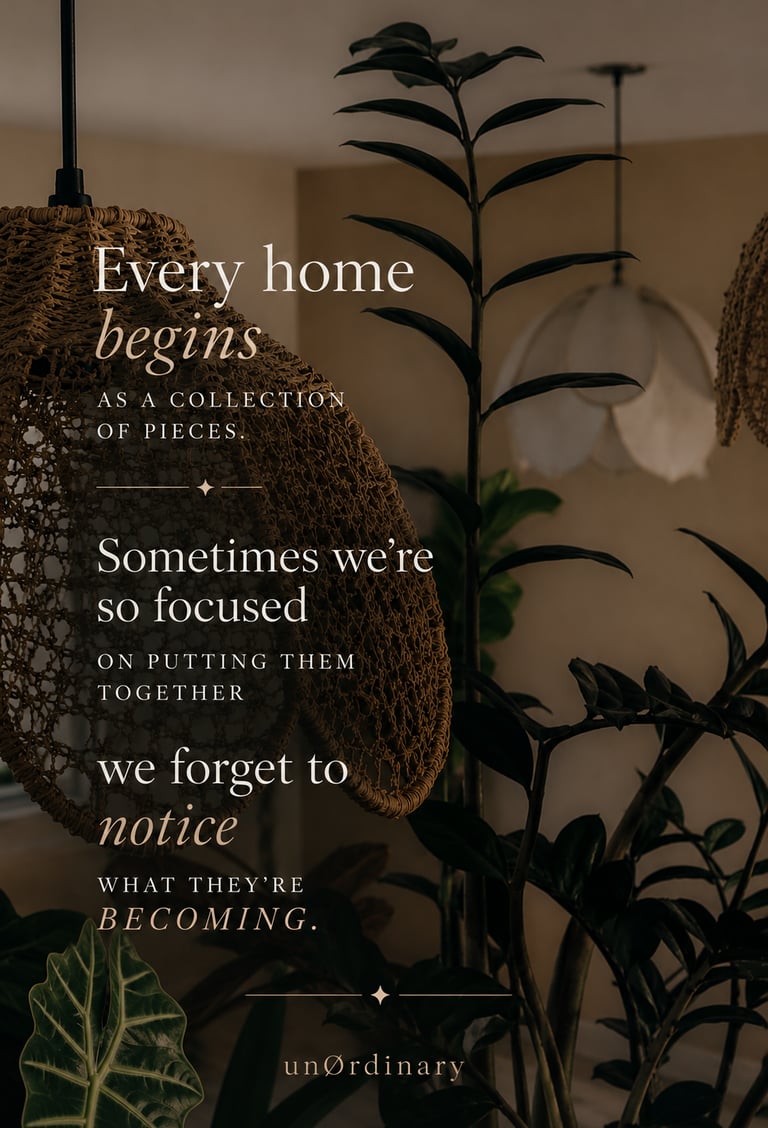
There’s a moment in life when you realize the problem was never only the thing in front of you.
It was the way you were looking at it.
Most of us don’t notice this at first. We assume life is something that happens to us—structured, external, fixed. Something we respond to step by step, instruction by instruction, trying to get it right as we go.
But perception is doing far more work than we give it credit for.
We don’t just experience reality. We interpret it.
And then we start believing the interpretation is the reality.
The Limits of Step-by-Step Thinking
When we’re in unfamiliar territory, we reduce life to steps. It’s the only way the mind can make something vast feel manageable.
Step one. Figure it out.
Step two. Fix it.
Step three. Move on.
But step-by-step thinking has a quiet limitation: it only sees what is immediately in front of it. It cannot yet hold the shape of what is becoming.
And so we begin to mistake incompleteness for failure.
Uncertainty for misalignment.
Delay for wrongness.
Confusion for the absence of direction.
But in reality, most of life is not broken. It is in formation.
Einstein and the Problem of Perspective
Einstein once said, “We cannot solve our problems with the same thinking we used when we created them.”
This is not just about intelligence or logic. It’s about vantage point.
Because the mind that is inside the problem cannot fully see the shape of the problem. It is too close. Too involved. Too entangled in its own interpretation of events.
From inside the experience, everything feels urgent, linear, and absolute.
But from a wider perspective, the same situation begins to look different...
Less like a crisis.
More like a system.
Less like chaos.
More like a pattern still unfolding.
Nothing changed except the distance of awareness.
Taoism and the Intelligence of Flow
Across centuries and cultures, philosophers have pointed to a different way of moving through life—one that does not rely on constant force or control.
Taoism calls it wu wei.
Often translated as “non-doing,” but more accurately understood as non-forcing.
It is the idea that life has a natural intelligence to it when we stop interrupting it with resistance. That things are not always meant to be pushed into place, but allowed to reveal themselves through presence.
This does not mean passivity.
It means participation without strain.
Action without tightening.
Engagement without over-control.
Most people confuse ease with inaction.
But wu wei is not absence of movement—it is alignment with it.
Joseph Nguyen and the Architecture of Thought
Modern psychology echoes something similar in a different language.
Joseph Nguyen writes that much of human suffering is not caused by life itself, but by our thinking about life.
This distinction is subtle, but critical.
Because what we call “stress” is often not the situation—it is the mental resistance layered on top of it. The urgency. The story. The interpretation that says: this should not be happening like this.
But life is rarely asking for immediate resolution.
The mind is.
And when we believe every thought with equal authority, we begin to treat temporary mental states as permanent truths.
We tighten around experiences that are still forming.
We rush processes that are still unfolding.
We try to finalize what is not finished.
And in doing so, we lose contact with the moment itself.
The Illusion of Control
Control often feels like clarity, but it is frequently just fear wearing structure.
We try to organize outcomes so tightly that we forget to observe what is actually happening.
We attempt to script life so precisely that we miss its intelligence in real time.
But life does not unfold according to our instructions.
It unfolds according to participation.
There is a difference between directing everything and noticing what is already moving.
One creates tension...
The other creates awareness.
The Space Between Effort and Ease
There is a point where effort becomes counterproductive—not because effort is wrong, but because over-effort begins to distort perception.
You stop seeing what is actually in front of you.
You only see what you are trying to force.
This is where stepping back becomes essential—not as avoidance, but as recalibration.
To pause is not to abandon the process.
It is to re-enter it with a clearer perception.
Sometimes the most intelligent thing you can do is temporarily stop interacting with the problem so you can see it again without distortion.
Returning to What Is Unfinished
There is wisdom in leaving things incomplete without collapsing into urgency.
Not everything requires immediate resolution.
Not everything improves under pressure.
Not everything is meant to be held continuously.
Some things need space to settle before they can be understood.
And when you return, you are not the same mind that left.
The problem has not necessarily changed.
But you have.
And sometimes, that is enough for the solution to appear.
A Different Way of Living
Perhaps the real shift is this:
Not learning how to control life better—but learning how to see it differently.
To recognize when you are inside the frame versus when you are observing the frame.
To notice when thought is compressing reality instead of clarifying it.
To loosen the grip just enough for something else to emerge.
Because life is not only something to be solved.
It is something to be perceived.
And perception changes everything.
---
There is a quiet intelligence in stepping back.
A quiet clarity in not forcing what is still forming.
A quiet strength in returning without urgency.
And over time, you begin to realize:
You were never only building outcomes.
You were learning how to see.
Ordinary Things
It's easy to think our surroundings are just background scenery.
But perception doesn't exist in isolation. The environments we inhabit quietly shape how we experience our days, influencing our attention in ways we rarely notice.
Not everything that changes us arrives as a major life event.
Sometimes it's a conversation.
Sometimes it's a new perspective.
And sometimes it's simply the atmosphere of a space we return to again and again.
For those who have asked, the lights featured throughout these photos can be found here:
Privacy Policy — Terms & Conditions — Community Guidelines — Contact Us
Copyright©️2025, UN0RD1NARY, Mariagrazia Colletti, All Rights Reserved.